Fragrance · 13 September 2026
How to Select the Right Perfume for You – Perfume Scents
Perfume is part of how we present ourselves, as telling as the clothes we wear and the accessories we choose. Yet with so many fragrances on offer, finding one that genuinely suits you can feel daunting.
Perfume is part of how we present ourselves, as telling as the clothes we wear and the accessories we choose. Yet with so many fragrances on offer, finding one that genuinely suits you can feel daunting.
The worst approach is to stand in a shop and sniff your way along the counter. After a handful of testers your sense of smell is overwhelmed, and you risk leaving with something that never feels right once you get it home.
Several underlying factors change the way a fragrance behaves on your skin, including body temperature, diet and hormones. That is why a scent that smells wonderful on someone else may fall flat on you.
Match the Concentration to Your Skin
Some perfumes are powerful; others are delicate. The difference comes down to concentration, and there are five broad categories:
- Parfum
- Eau de parfum
- Eau de toilette
- Eau de cologne
- Eau de fraîche
Parfum is the strongest, containing the highest proportion of essential oils and perfume extracts. Eau de parfum, eau de toilette, eau de cologne and eau de fraîche follow in descending order of strength.
Which concentration suits you depends on your skin type and your own preferences.
Oily skin tends to amplify a fragrance, because scent mingles with the skin’s natural oils. If that sounds like you, a lighter concentration such as an eau de toilette is often enough, and a small application will last well. Dry skin, by contrast, lets fragrance evaporate quickly, so a richer eau de parfum is a better match, or more frequent spraying if you prefer something lighter. Those with sensitive skin should steer clear of the strongest concentrations.
Understand a Fragrance’s Notes
Perfumery is one of the more exotic arts still practised today. Ingredients are blended in varying proportions to build distinct layers, and those layers are known as notes. Every fragrance has three: top, heart and base.
Top notes are the first impression, hitting the senses immediately after application. They evaporate within five to fifteen minutes, making way for the heart notes, sometimes called middle notes. Heart notes make up around 70 per cent of a perfume and last far longer. Base notes arrive after roughly half an hour and remain until the scent finally fades. Together the three create the complete fragrance.
Knowing the notes before you buy makes a real difference. Take a popular men’s eau de toilette as an example: it opens with a crisp citrus impression, built on rhubarb and lavender blended with violet leaf. After a while the heart emerges, with orange, black pepper and sage. Finally the base settles into sandalwood, cashmere wood and cedar.
How to Test a Fragrance Properly
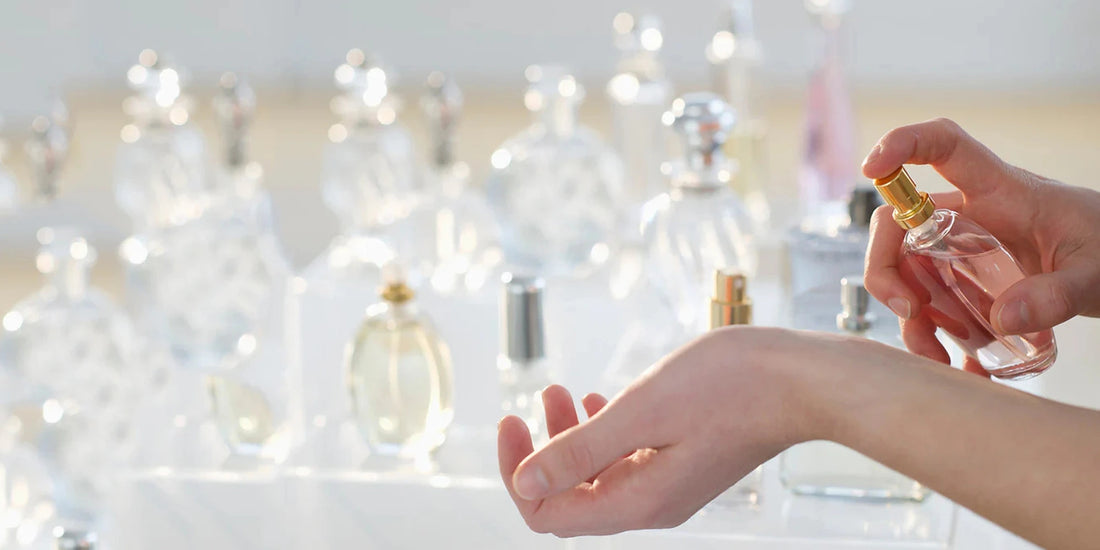
Apply to your wrists and pulse points. These areas are warmer than the rest of the body, which helps the fragrance develop and release the notes you are meant to smell.
Never judge a scent on the first sniff alone; that is only the top notes. Wait at least fifteen minutes to reach the heart notes, and an hour to reach the base. Leaving it on for two to three hours is better still. Everyone’s skin chemistry differs, so the same perfume can behave quite differently from one person to the next.
Choosing by Skin Type
Pheromones, hormones and skin type all alter how a fragrance develops. A perfume may open beautifully and still fail to settle well on your skin. Here is how to choose across three common skin types.
Women
Dry skin. Dry skin interferes less with a fragrance’s notes, but it lacks the oil and moisture needed to hold a scent in place. A strong, less volatile perfume is a good fit, since it lingers far longer. Musky scents work particularly well.
Oily skin. Oily skin is recognisable by the sebum secreted by the sweat glands, a substance that helps the skin retain fragrance and blends with it. The resulting scent is unique to the wearer. A heavy perfume is unnecessary here; an eau de toilette with citrus or floral notes gives a pleasant result that is neither overpowering nor faint.
Sweaty skin. Moisture matters for holding and enhancing a scent, but hydrated skin and sweaty skin are not the same thing. Sweat can fade or distort perfume notes, and it is especially troublesome as it evaporates and exposes the volatile elements of a fragrance. Avoid eau de toilette and cologne if you perspire heavily. A chypre floral eau de parfum is a better choice: floral, lifted by bright citrus, and concentrated enough to last longer on the skin. It suits energetic, vibrant personalities.
Men
Although more houses now produce unisex fragrances, men and women often gravitate towards different scent families. Where women frequently choose stronger, longer-lasting scents, men often reach for a good eau de cologne. Skin type still plays a large part in the decision.
Dry skin. An eau de cologne is not the best choice for dry skin, as the scent fades quickly. A more concentrated eau de parfum will hold without constant reapplication.
Oily skin. Men generally have a stronger natural body odour, which can distort a fragrance, and oily skin amplifies it further. The result may smell good, but a powerful scent can overwhelm anyone standing nearby. A moderate application of an eau de cologne with summery notes is ideal.
Sweaty skin. If you sweat heavily, an eau de cologne or eau de fraîche will lose its scent quickly and need reapplying. An intense eau de parfum, by contrast, develops real strength when it mixes with sweat. A modern eau de toilette built on woody floral musk is a strong option, complementing a confident character. Top notes of juniper berries and rosemary give way to citrus, grounded by cedar in the base. It handles sweaty skin well and still smells fresh to those around you.